

Why Mark Carney Needs to Explain Himself
A career built on resisting public opinion now collides with the realities of democratic leadership

Mark Carney’s greatest strength may also be his greatest risk.
For most of his professional life, Carney was rewarded for ignoring public opinion. As Governor of the Bank of Canada and later at the Bank of England, his job was not to persuade or empathize with voters. It was to resist them. To tune out the noise. To make decisions based on models, forecasts, and long-term stability, even when those decisions were unpopular.
In those roles, public opinion was something to be managed at arm’s length. Communication mattered, but only insofar as it protected credibility and avoided panic. The goal was neutrality. Independence and distance from politics and emotion was essential.
That instinct is likely deeply ingrained. And it made him a good central banker.
It will not make him a successful prime minister on its own.
As I’ve argued on this site in the past, as Prime Minister, Carney now operates in a system where authority flows not from expertise, but from consent. The tools and expectation are different. And the tolerance for opacity is far lower.
In a democracy, especially one defined by economic anxiety and institutional fragility, people do not simply want leaders who are right. They want leaders who explain themselves: repeatedly, clearly and in human terms.
This is the adjustment Carney still appears to be making.
In his year-end interviews, there were moments where the central banker resurfaced. The careful phrasing. The assumption that the logic should speak for itself. The expectation that reassurance alone will suffice. It often does not.
Canadians today are not calm market actors. They are households under pressure. Workers worried about their jobs. Parents anxious about housing, affordability, and whether the future will be better or worse for their kids. They are living with a precarity mindset.

In that environment, silence feels like indifference while abstraction can feel like distance.
This is why Carney might need to show up to press conferences differently.
Here me out on this one. He needs to show up not with vibes but with visuals.
Suggestion: Bring PowerPoint slides.
It sounds trivial, I understand, but it is not. Slides force structure and force clarity. They require leaders to spell out assumptions, trade-offs, and outcomes. They signal respect for the audience and authority in the speaker.
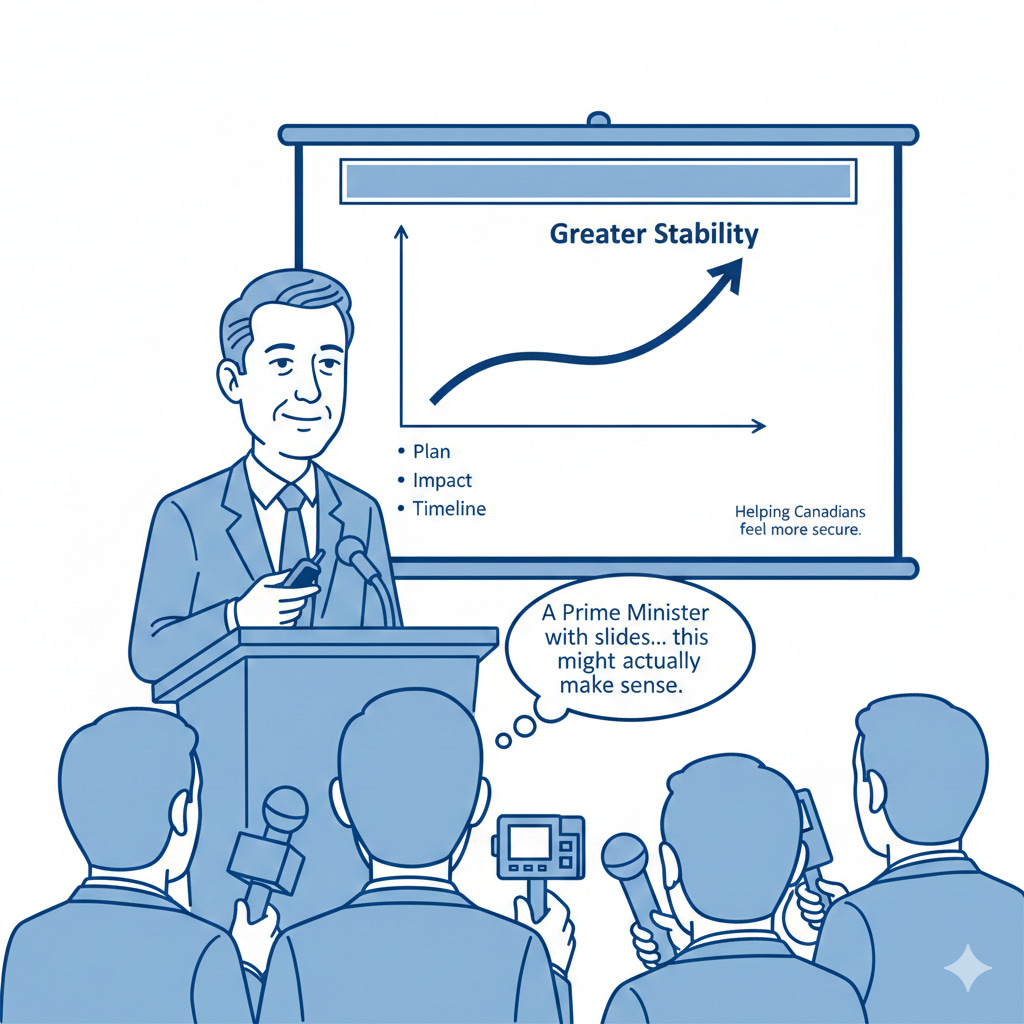
Imagine a Prime Minister who walks Canadians through the plan. Here is what we are trying to fix. Here is why this approach makes sense. Here is what success looks like. Here is when you should expect to feel it. Here is what might go wrong.
That kind of transparency does not weaken authority. It builds it. And its so different than anything else we’ve seen before.
In my work asking people questions, I see how people respond when leaders explain their thinking in plain language. Even skeptics become more patient and some opponents soften when they feel informed rather than managed. People are far more willing to grant room to manoeuvre when they understand the destination.
Central bankers are trained to believe that too much explanation invites misinterpretation. Politicians must believe the opposite. That without explanation, people will invent their own story. And those stories are rarely generous.
The irony with Prime Minister Carney is that the very discipline that defined his earlier career must now be balanced with something messier: Emotional literacy, lots of repetition, and a willingness to explain the obvious.
Public opinion is not a constraint to work around. It is the terrain on which governing happens.
If Mark Carney can make that shift, from resisting public opinion to respecting it, I think he can turn his seriousness into lasting authority.
As I constantly remind clients and my students at Carleton University, in politics, permission is the currency. And it must be renewed in public.