

Mark Carney's "Variable Geometry" Requires Connection to the Daily Lives of Canadians
Another need to take the macro and make it micro for people

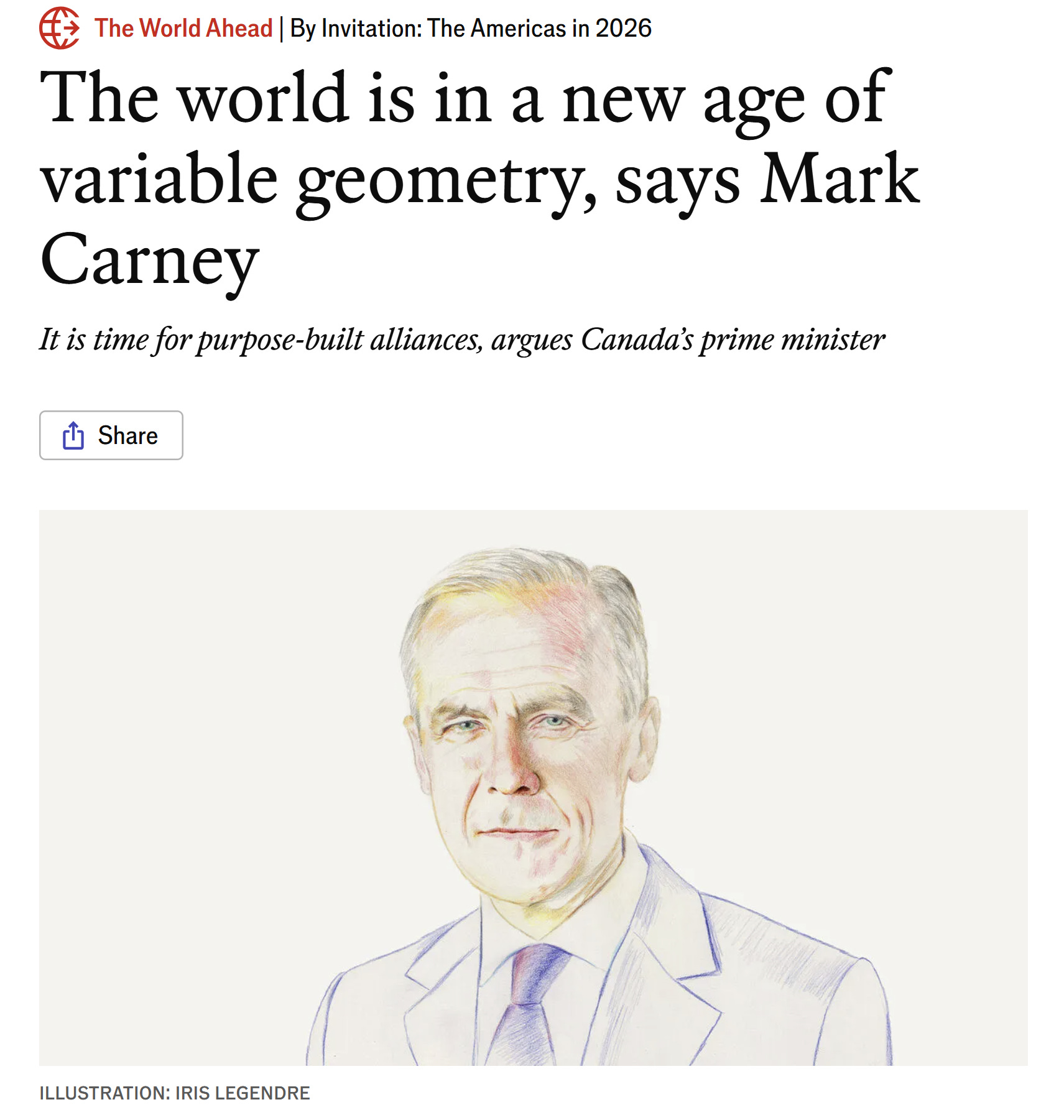
Mark Carney’s November 2025 essay in The Economist laid out a clear diagnosis of the world Canada is now navigating. He argues that the post–Cold War system of rules and institutions is no longer delivering stability. Geopolitical conflict, economic nationalism, and stalled global organizations have exposed how fragile that old order had become.
His response is pragmatic and something he refers to as “variable geometry”. He notes that countries are adapting by working together in smaller, more flexible partnerships focused on specific goals. These arrangements move faster, adjust more easily, and are better suited to uncertainty than universal rules and slow moving institutions.
The strategy is makes sense to me given the world we are in.
But the challenge ahead for Carney is not intellectual. It is political and emotional. Canadians will not evaluate this approach based on its coherence as a foreign policy framework. They will judge it based on whether life feels more stable, more affordable, and more predictable.
As someone who spends his life talking to people, asking questions, exploring how and why people understand what they do, that is the key translation task.
Canadians do not experience geopolitics directly. They experience prices, availability, reliability, and stress. If Carney wants his broad strategy to resonate, it has to be communicated and delivered in ways that connect to those daily signals.
The first lesson is to lead with stability, not structure.
Most people do not care how international cooperation is organized. They care about outcomes.
Carney should consistently anchor his message in what his approach is designed to protect. Steadier food prices. More reliable access to goods. Fewer sudden shocks that make household budgets harder to manage.
This does not require oversimplifying the world. It requires starting with lived experience. When people feel that life has become harder to plan, they are open to explanations. But those explanations must begin with their reality, not with institutions.
The second lesson is to talk about preparation, not control.
Canadians are realistic. They know governments cannot prevent every crisis. What they want is confidence that the country is ready when disruptions happen. Carney’s emphasis on resilience fits this perfectly, but the language needs to be grounded.
Preparation shows up in practical ways. Backup systems. Diverse sources of supply. Infrastructure that works during extreme weather. Services that do not collapse when demand spikes. These examples help people understand that resilience is not abstract. It is about reducing the frequency and severity of disruptions in daily life.
The third lesson is to make trade offs explicit and honest.
One of Carney’s strengths is credibility. He should use it.
Building resilience often costs more upfront. It can look less efficient in the short term. Canadians are more willing to accept that reality than politicians often assume, especially if the alternative is repeated crises.
Polling consistently shows that most people are tired of volatility. They want reassurance, even if it comes with constraints. Being upfront about trade offs builds trust and positions Carney as a leader who respects people enough to tell them the truth.
The fourth lesson is to localize the strategy.
Big ideas land best when people can see themselves in them. Carney’s strategy should be illustrated through concrete examples tied to regions and communities. A port that moves goods more reliably. A food processing facility that keeps shelves stocked. A research partnership that improves healthcare access. A trade corridor that protects local jobs.
These are not side stories. They are the proof points that make the strategy real.
The fifth lesson is to emphasize reliability over growth.
Economic growth matters, but right now Canadians are more focused on whether the system works than on whether it is expanding. Carney’s worldview is well suited to this moment. It prioritizes systems that hold under pressure rather than ones that only perform in ideal conditions.
Framing success as fewer disruptions, fewer surprises, and more dependable services aligns closely with what people say they want when asked open ended questions about the economy.
The final lesson is to adopt a governing tone, not a campaigning one.
Carney’s essay reflects seriousness, restraint, and pragmatism. That tone should carry through to how he speaks to Canadians. Avoiding slogans. Acknowledging uncertainty. Showing how decisions fit into a larger plan. This is especially true in contrast to Pierre Poilievre’s approach.
People are more likely to trust a leader who admits the world is unstable but demonstrates a clear approach to managing that instability.
The opportunity for Carney is significant. His strategy offers a way to govern in an age of uncertainty without promising certainty. If he can consistently translate global complexity into everyday reassurance, Canadians will not need to fully understand his framework to support it (like the federal budget).
They will simply feel that life is a little more predictable. And from a public opinion perspective, that is what success looks like.