


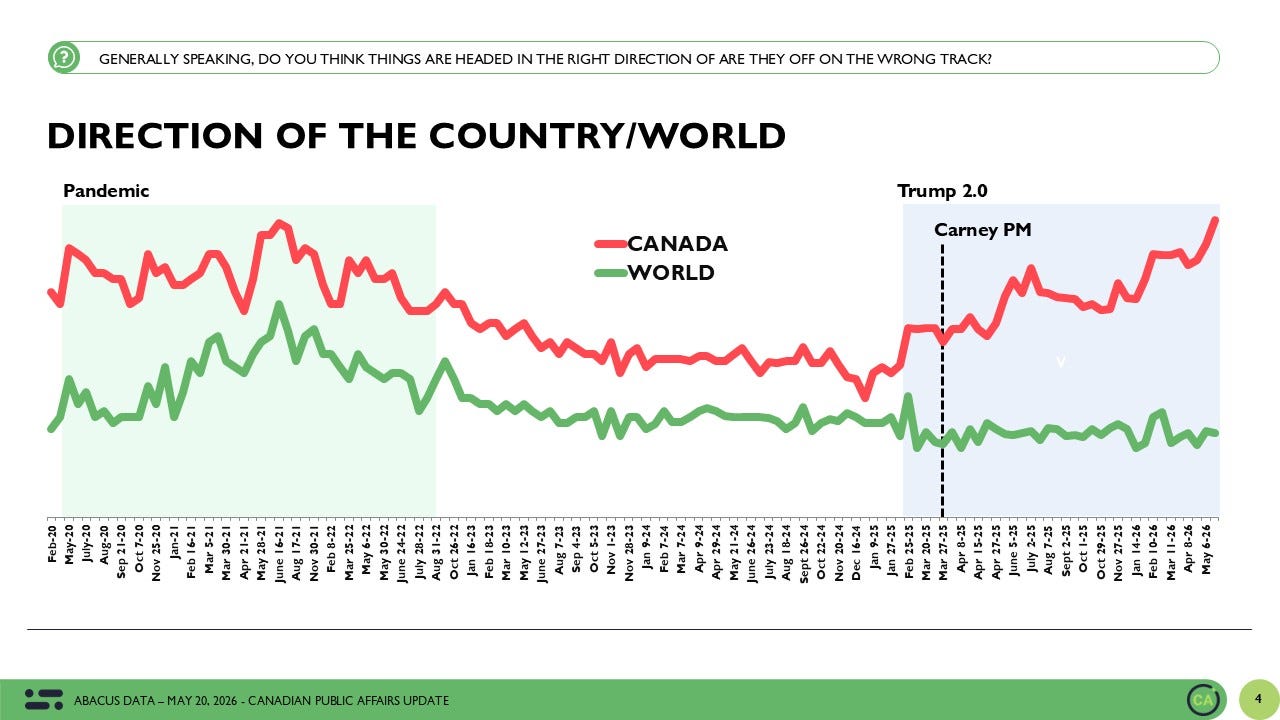
The latest Abacus Data national poll, released on Sunday, finds 47% of Canadians think the country is headed in the right direction. Abacus tracking shows this is a decade-long high. On its own, always think this number matters but in context, I think this number matters more.
Beyond this one measure, the specific issue agenda still looks hard. Cost of living leads as the most cited national issue at 66%, followed by the economy, Donald Trump and his administration, health care, and housing. Many Canadians continue to feel they are falling behind. Most have what we called a precarity mindset.
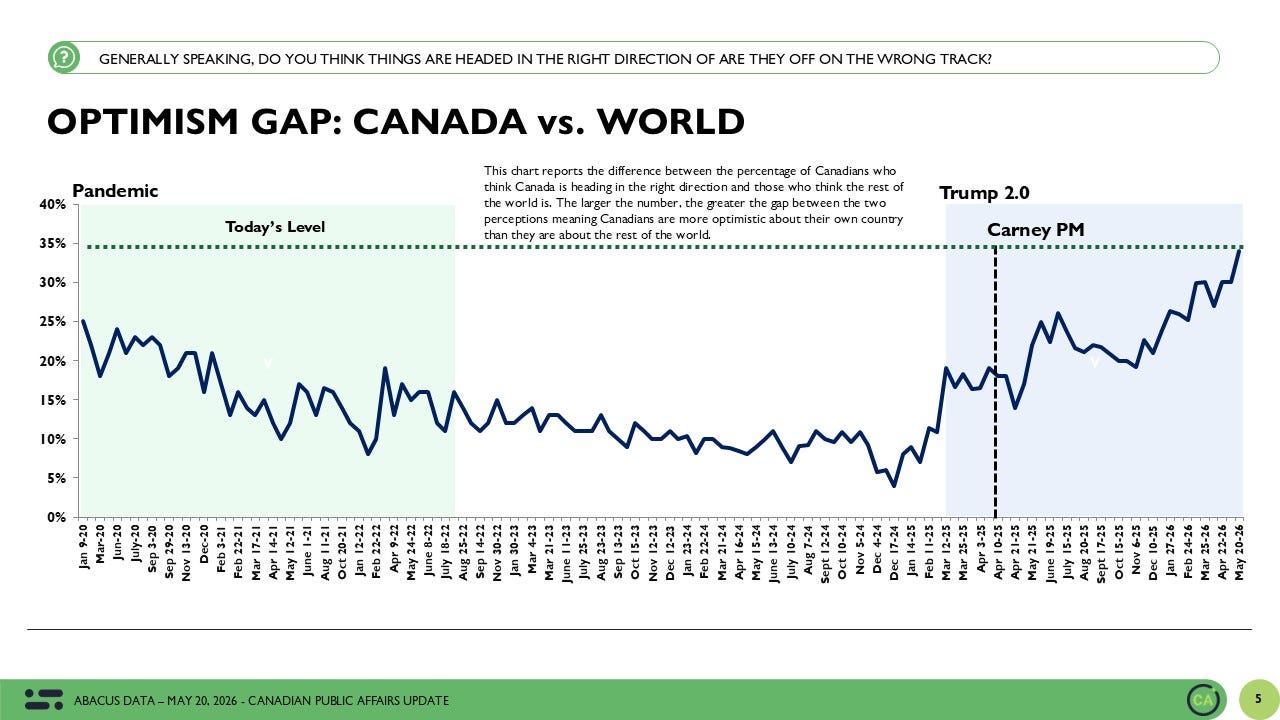
But it’s this new found asymmetric optimism is fascinating to me. Canadians are more positive about Canada while remaining deeply negative about the world and the United States. They are anxious about external shocks, but more willing to see Canada as a place with some protection from those shocks. It’s like Canada has become like good shocks on a car - absorbing the bumps and potholes on the road people have little agency to control.
As I’ve watched this line on the chart below increase, I’ve been thinking about the impact of this optimism on politics, advocacy, and public affairs more generally.
A pessimistic electorate narrows minds. People look for relief. They punish governments. They discount big plans because big plans feel like risk.
In contrast, an optimistic electorate listens longer. People grant others more time. They accept trade-offs when the path feels credible. They become more open to ambition when ambition feels connected to security.
This does not mean Canadians are asking for disruption. The precarity mindset still matters. Our work from 2025 described the shift from scarcity, concern about access to essentials today, toward precarity, concern about whether core systems will hold over time. Global instability, economic volatility, and threats from the United States moved many Canadians from short-term squeeze toward longer-term insecurity.
I think political psychology helps explain this “split brain” phenomenon. Anxiety and optimism do not cancel each other out. They often coexist. Affective intelligence theory, developed by George Marcus, Russell Neuman, and Michael MacKuen, argues emotions help citizens decide when to rely on habit and when to pay attention. Anxiety increases attention. Enthusiasm strengthens attachment. Applied to Canada today, world anxiety keeps people alert. Domestic optimism strengthens attachment to the national project.
Behavioural economics adds a second layer. People assess gains and losses against a reference point. Prospect theory and related work on loss aversion show losses carry more weight than equivalent gains. The endowment effect and status quo bias point in the same direction. Once people see something as valuable and already theirs, they become reluctant to risk losing the value.
Canada, in this mood, becomes the reference point.
Think about it this way: A country with working institutions, relative stability, and a governing style many perceive as serious becomes more valuable when alternatives look volatile. This does not make voters complacent but I do think it makes them protective. The outside world raises the perceived value of the domestic status quo.
This is where Mark Carney matters.
